Site energy discovery
We collect current load behavior, backup priorities, charging expectations, roof or land constraints and utility tariff signals so the project begins with an operational baseline instead of a generic product bundle.
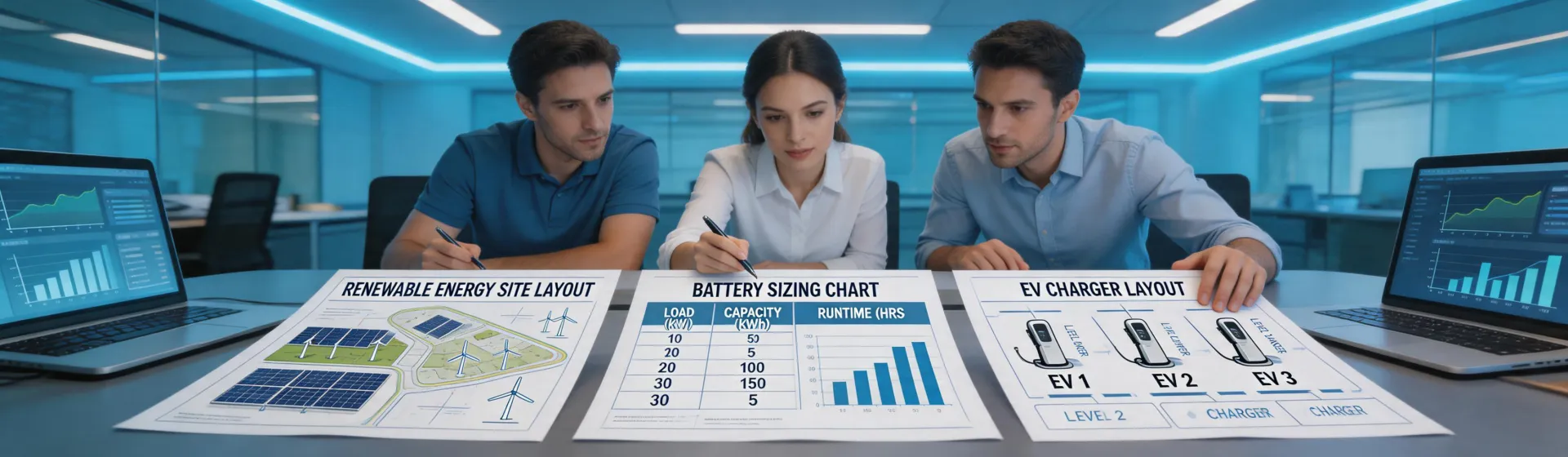
Tesla project support starts before equipment selection. The service path combines load discovery, storage sizing, solar production review, EV charging demand planning, utility interconnection awareness and monitoring handoff. The goal is to help owners move from a broad renewable energy ambition to a buildable scope that installers, electrical contractors, facility teams and finance stakeholders can understand.
We collect current load behavior, backup priorities, charging expectations, roof or land constraints and utility tariff signals so the project begins with an operational baseline instead of a generic product bundle.
Battery storage, solar generation, inverter choices, EV charging and controls are mapped into a practical architecture. The review identifies retrofit constraints, new-build opportunities and the sequencing needed for phased deployment.
Technical notes are structured for installers and electrical contractors, including one-line diagram assumptions, gateway placement, service entrance limits, communications needs and commissioning checkpoints.
After installation, dashboards and reporting routines help teams follow state of charge, solar production, charger demand, outage performance and early indicators of equipment or operational drift.
Interval load data can be reviewed to find storage and charging demand windows.
Solar, storage, charging and control logic are checked together during planning.
Battery warranty assumptions are documented before procurement discussions advance.
Commissioning notes are organized for owners, contractors and support teams.
The service program is deliberately practical. A homeowner may need to know which circuits should remain powered during an outage and how much solar energy can be stored for evening use. A commercial owner may need to understand demand charges, transformer limits and the operational impact of adding employee or fleet charging. A utility or independent power producer may need clearer documentation around battery containers, inverter stations, monitoring data and long-term maintenance responsibilities. Tesla service work translates those needs into an energy narrative that can be used by procurement, engineering and construction stakeholders.
Every recommendation is written in plain English first, then supported with technical details where they matter. That keeps decision makers aligned while still giving engineers the inputs they need for design review. The service team can discuss capacity ranges, chemistry considerations, AC and DC coupling tradeoffs, monitoring architecture, safety disconnects, local permitting questions and future expansion paths. This approach reduces rework because assumptions are visible before equipment is ordered or installation labor is scheduled.
Share load data, roof plans, charger counts or backup priorities. Tesla will help structure the next technical conversation.
Request Service Review